We re-read these official pages on a rolling basis. When one changes, the new figure is checked by a person before it appears here.
What a year costs
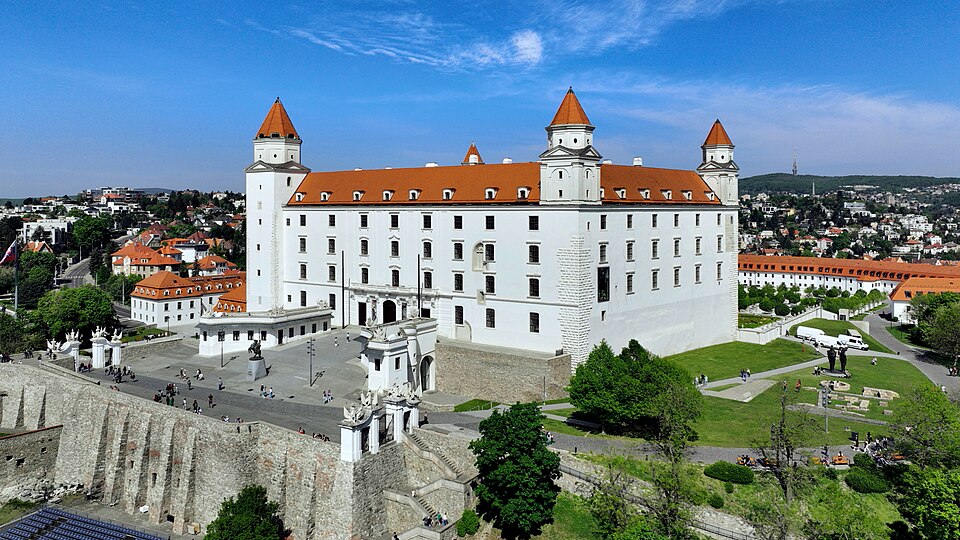
Tuition. Study in Slovakia, run by the Slovak Academic Information Agency (SAIA), states that full-time students pay no tuition for programmes taught in Slovak, provided they do not exceed the standard length of study. Programmes in foreign languages charge fees, which range from €500 to €12,200 a year. The European Commission's Study in Europe profile gives a similar €750-€11,000 a year.
At the Slovak University of Technology in Bratislava (STU), English-taught programmes cost up to €4,000 a year, and Slovak-taught study is free. Medicine and dentistry in English at the medical faculties sit at the top of the national range; check the faculty's own fee schedule for your start year.
Living costs. Study in Europe estimates a minimum of about €350 a month and a comfortable budget of €500-€700 a month. Expect Bratislava to sit at the top of that range. Apply for a dormitory place as soon as you accept your offer.
The visa
Slovakia grants a temporary residence permit for the purpose of study, not a student visa. You apply to the Foreign Police, either in Slovakia or at a Slovak embassy abroad. If you need a visa to enter, the embassy can issue a national visa so you can travel and collect your permit.
Fees. The application for temporary residence for study is free. You pay €4.50 for the residence card (issued within 30 days) or €24.50 for expedited issue within two working days, according to SAIA. The Ministry of Foreign and European Affairs lists the national visa at €14 where it is needed in connection with a residence permit already granted, and €90 where the visa is issued so you can apply for residence at the Foreign Police in Slovakia.
Processing: now 90 days. From 15 July 2026, the Foreign Police decide on applications for granting or renewing temporary residence for study within 90 days, according to the IOM Migration Information Centre. Earlier sources, including the Ministry's page, say 30 days. Plan for 90.
The money. You must show that your stay is financially secured in the amount of the subsistence minimum for each month of stay. The subsistence minimum for an adult is uprated every 1 July; the IOM Migration Information Centre shows €295.22 a month after the July 2026 uprating, up from €284.13 from July 2025. For a year that is about €3,543. The Ministry accepts:
- A bank statement covering the last three months
- A scholarship confirmation
- A confirmation from a legal entity covering your costs, or an affidavit of support with the sponsor's bank statements
Documents must be no older than 90 days. University students do not need to submit proof of accommodation.
The subsistence minimum is a legal floor far below what living costs. Do not budget to it.
Working while you study
With temporary residence for study at a university, you can work without a work permit up to 80 hours a month, according to the Ministry of Foreign and European Affairs (page updated 16 December 2024). The European Commission's immigration portal still shows the older rule of 20 hours a week; the Ministry's figure is the more recent. To work more, you must apply to change the purpose of your residence.
That change is now harder. Since 1 July 2025, you can switch from study residence to another purpose at the Foreign Police only after successfully completing your studies, and a switch to business is allowed only after 24 months.
After you graduate
Two options, according to the IOM Migration Information Centre (updated 31 July 2026):
- 30 days: your study residence stays valid for up to 30 days after completing your degree, a protective period in which you can look for work
- 9 months: you can apply for a nine-month renewal of your study residence to look for a job or start a business. Apply in person or electronically at the Foreign Police, no later than the last day your current residence is valid, with a notarised copy of your diploma
This applies to bachelor's graduates too. During the job search you can work without a work permit and without the employer needing confirmation that the vacancy can be filled, provided you hold lawful residence.
Language
Slovak-taught degrees are free, but require Slovak. SAIA notes that universities offer preparatory Slovak language courses for international students who want to study in Slovak.
English-taught programmes are concentrated in medicine, dentistry, engineering, IT and economics. English requirements are set by each university and faculty; check the programme page.
Outside the university, the Foreign Police, landlords, doctors and most employers work in Slovak. English goes further in Bratislava than elsewhere, but graduate jobs outside international companies generally expect Slovak.
When to apply
Each university and faculty sets its own admission rules and deadlines. SAIA gives the general pattern:
- Most programmes: deadline usually the end of February or March
- Arts institutions: usually the end of November
- Entrance exams: between June and September (arts in January)
Before admission, your previous education must be recognised in Slovakia. Allow time for this.
For non-EU students the residence process is now the binding constraint: 90 days for the decision, plus time for the embassy appointment and the residence card. For a September start, aim to hold an offer and file your residence application by May.
What to watch out for
Processing times tripled in July 2026. The 90-day decision period for study residence applies from 15 July 2026. Pages quoting 30 days are out of date. File as early as your documents allow.
The work limit is written two ways. The Ministry states 80 hours a month; some EU and older pages say 20 hours a week. Stay within the Ministry's figure, and ask your faculty's international office if you are unsure.
You cannot switch to a work permit mid-degree. Since July 2025 you must complete your studies before changing the purpose of your residence at the Foreign Police. Plan your finances on the basis that you will stay a student, within the hours limit, until you graduate.
Your funds evidence expires. Bank statements and other documents must be no more than 90 days old when you apply. Get fresh statements just before you file, not months earlier.
Free tuition has conditions. Slovak-taught study is free only within the standard length of study. Repeating a year or exceeding the standard period can trigger fees.
Where these numbers come from
| Figure | Source | Checked |
|---|
| Subsistence minimum for each month of stay | Ministry of Foreign and European Affairs, Embassy in Yerevan | 24 Sep 2026 |
| €295.22 subsistence minimum (after July 2026) | IOM Migration Information Centre | 24 Sep 2026 |
| €284.13 from July 2025, change-of-purpose rules from 1 July 2025 | IOM MIC, July 2025 changes | 24 Sep 2026 |
| 90-day decision from 15 July 2026 | IOM MIC, July 2026 changes | 24 Sep 2026 |
| 80 hours a month, €14 / €90 national visa, funds evidence | Ministry of Foreign and European Affairs, foreign students | 24 Sep 2026 |
| Free application, €4.50 / €24.50 card, no accommodation proof | SAIA, Research in Slovakia | 24 Sep 2026 |
| 30 days and 9-month renewal after graduation | IOM MIC, graduates, updated 31 July 2026 | 24 Sep 2026 |
| Free Slovak-taught study, €500-€12,200 fees, deadlines | Study in Slovakia (SAIA) | 24 Sep 2026 |
| STU fees up to €4,000 | Slovak University of Technology | 24 Sep 2026 |
| €750-€11,000 fees, €350 / €500-€700 living costs | European Commission, Study in Europe: Slovakia | 24 Sep 2026 |
| Older 20 hours a week rule | EU Immigration Portal, student in Slovakia | 24 Sep 2026 |
Rules change, sometimes at short notice. Every figure above carries the date we checked it. Check the official source before you rely on it, and note that we could not load the Ministry of Labour's own page for the July 2026 subsistence minimum, so the €295.22 figure is taken from the IOM Migration Information Centre.
Immigration and fee rules change, sometimes at short
notice and sometimes without announcement. Every figure above carries the date we checked it
and a link to the official source. Check that source before you rely on it.

 United States
 Canada
 Australia
 Netherlands
 Ireland
 Japan
 Cyprus
 Studying in Slovakia